25 Sept 2026
A recent policy paper published by the Energy Watch Group argues that simply cutting emissions is no longer enough to stop global warming. Authored by climate policy experts and marine biologists, including Hans-Josef Fell, Franziska Pausch, Frank Schweikert, Prof. Victor Smetacek, and Heinrich Strößenreuther, the study presents a case for large-scale atmospheric carbon removal, pointing to the ocean as our most effective tool.
The 450 Gigaton Carbon Gap
Even if humanity reaches net-zero greenhouse gas emissions tomorrow, the concentration of carbon dioxide in our atmosphere will remain well above safe historical levels. Current CO₂ levels hover around 425 parts per million (ppm), whereas scientists identify 350 ppm as the threshold for a stable climate.
To return to safe limits and prevent critical climate tipping points, the authors calculate that we must remove roughly 450 gigatons of carbon (equivalent to 1,700 gigatons of CO₂) from the atmosphere over the coming decades. Land-based solutions like forest planting and direct air capture plants face limitations regarding land use, high energy demands, and extreme financial costs.
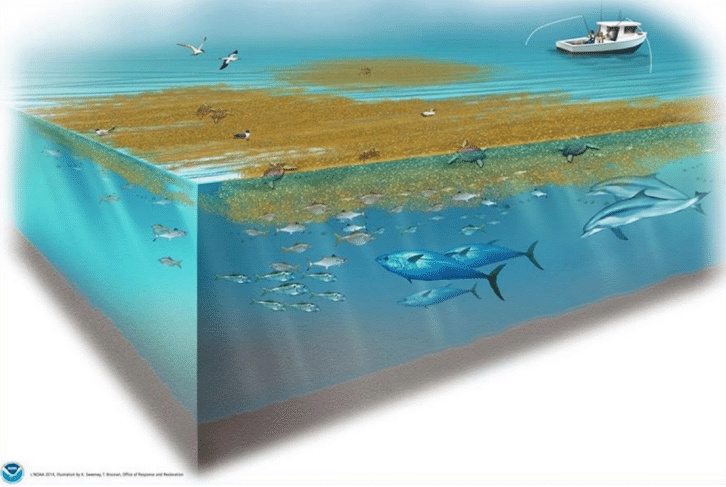
floating ecosystem on the surface of the open ocean, and the associated marine fauna, including fish, sea
turtles, birds, and marine mammals: https://oceanservice.noaa.gov/facts/sargassosea.html
From Coastal Nuisance to Global Solution
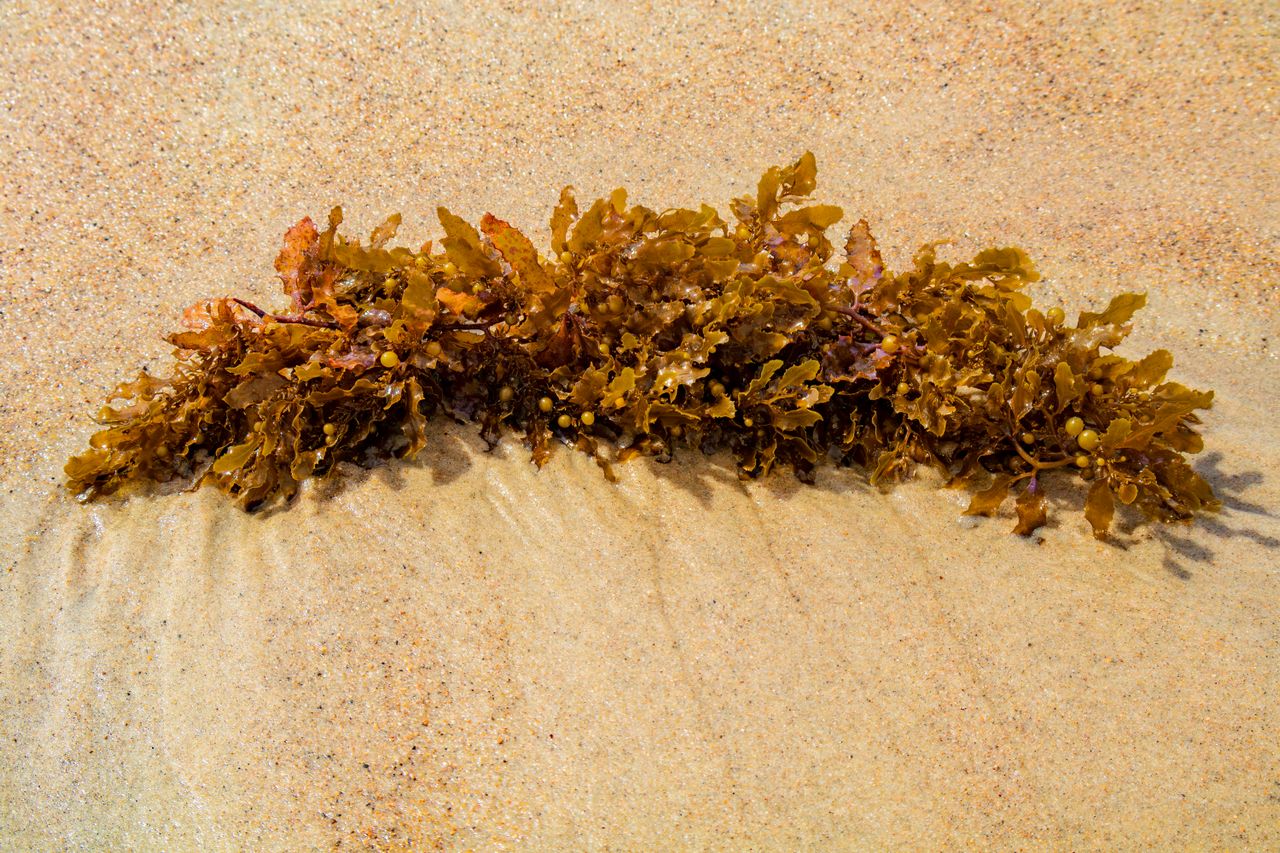
This is where free-floating seaweed, particularly Sargassum, enters the picture. In recent years, massive Sargassum blooms have washed ashore along the Caribbean and West African coasts, rotting on beaches, disrupting local tourism, and harming coastal marine life.
However, when managed properly in the open sea, Sargassum possesses extraordinary qualities:
- Rapid growth rates: Sargassum biomass can double in ten days or less.
- High carbon binding: Dried Sargassum is roughly 30 percent carbon by weight.
- Free-floating lifecycle: Unlike kelp, it completes its full life cycle floating near the surface without needing to anchor to the seabed.
By moving from passive cleanup to active containment, harvesting, and controlled ocean farming, we can turn a severe coastal hazard into a scalable carbon-capture industry.
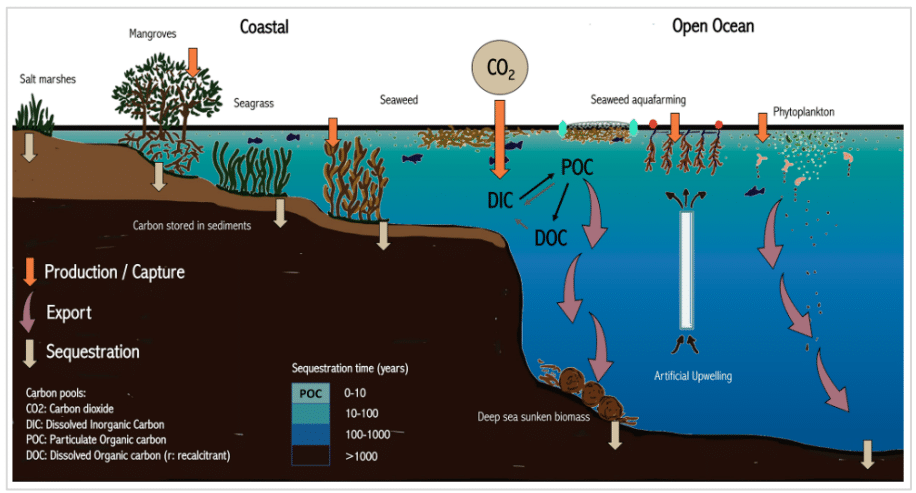
from https://journals.plos.org/climate/article?id=10.1371/journal.pclm.0000148
Creating Ecosystem Oases
The paper highlights the five massive subtropical gyres; often called the deserts of the ocean, which cover nearly half the planet’s surface. These vast areas have plenty of sunlight but lack surface nutrients. By bringing nutrient-rich deep water to the surface using simple vertical circulation systems, ocean farms can cultivate floating Sargassum carpets at scale.
Far from harming marine environments, these floating algae mats act as mobile marine habitats. In the wild, Sargassum mats provide shelter and feeding grounds for hundreds of species, including sea turtles, commercially vital fish species, and seabirds. Ocean farming in these barren gyres creates thriving marine oases while taking pressure off fragile coastal ecosystems.
Harvesting and Long-Term Value
Once harvested, Sargassum biomass can feed into sustainable industrial value chains on land:
- Building materials: Replacing traditional feedstocks with carbon-rich biomass.
- Bioplastics and bio-naphtha: Reducing reliance on petrochemicals.
- Biofuels and agricultural products: Generating renewable energy and organic soil enrichers.
When incorporated into long-lived products or permanently deposited in deep ocean sediments, the captured carbon is locked away safely.
Technology and the Road Ahead
Scaling ocean farming requires practical, robust technology capable of handling floating biomass efficiently. Tools designed to capture, contain, and gather floating weed, including vessels like the MegaShark, towed containment booms, and autonomous collection systems, are vital links in this value chain. They bridge the gap between open-ocean growth and onshore processing.
As the paper authors emphasize, cooling our planet requires practical courage and rapid testing of ocean-based solutions. By capturing Sargassum before it reaches our shores, we can safeguard coastal economies while building the foundation for large-scale planetary cooling.
Credit:
This blog post is based on findings from the policy paper “Cooling our planet with ocean farming: CO₂ removal as the third pillar of climate protection” (July 2025) by Heinrich Strößenreuther, Franziska Pausch, Hans-Josef Fell, Prof. Victor Smetacek, and Frank Schweikert (Energy Watch Group).