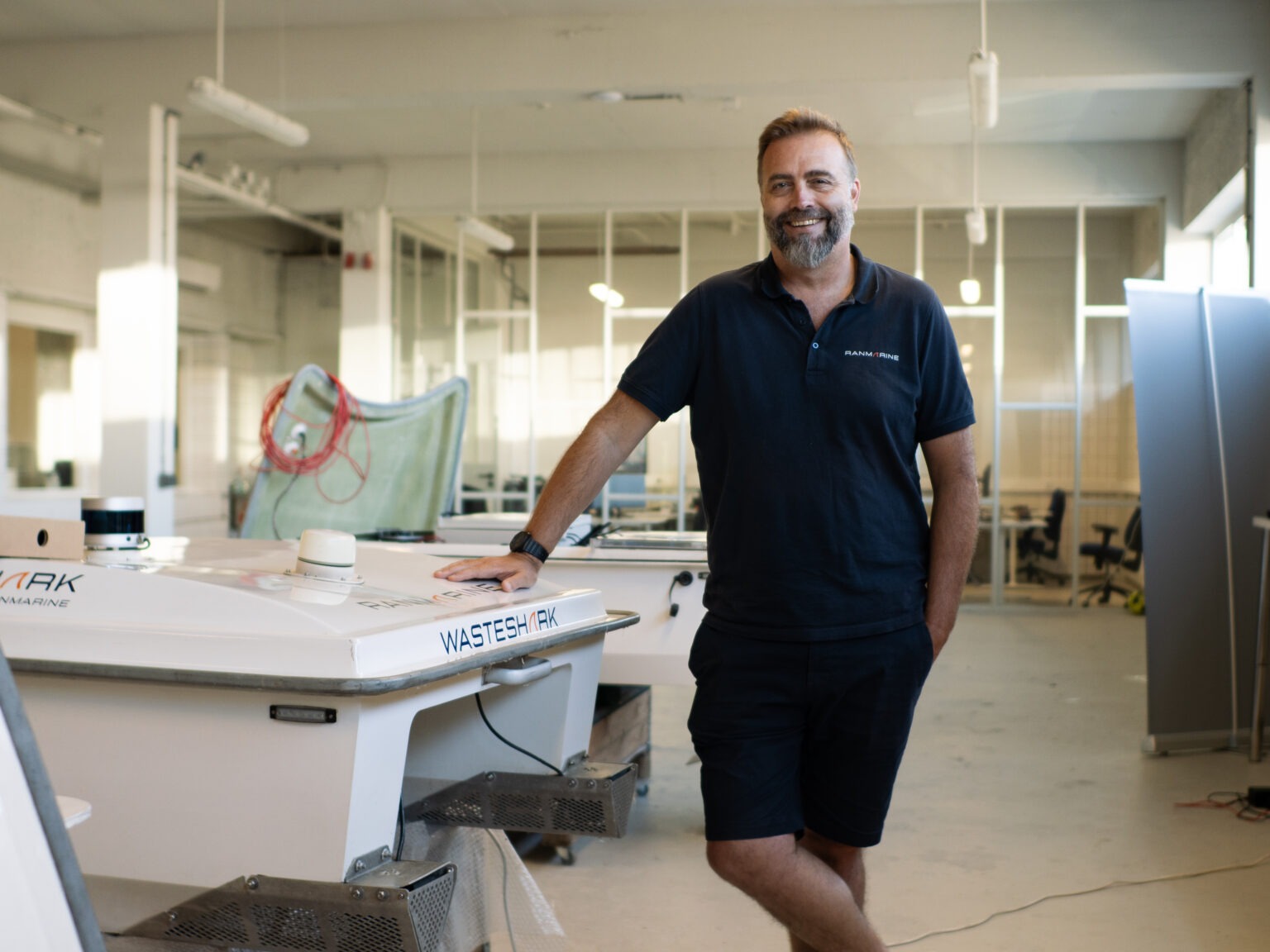
RanMarine was recently featured by Ondernemen010, the City of Rotterdam’s platform for local entrepreneurs, as part of their “Ook Jouw Zaak” (It Could Be Your Business Too) series. The team came to our Rotterdam base to film a short video with founder Richard Hardiman and to talk through how RanMarine turned an idea spotted on a Cape Town quayside into a fleet of autonomous robots now cleaning waterways around the world.
Fishing for waste
“The idea came about when I saw workers in Cape Town clearing waste from a harbour with nets on poles. I remember thinking: surely there’s a more efficient way to do this?” That question set Richard on the path to building an autonomous robot capable of collecting waste from the water around the clock. An accelerator programme eventually brought him to Rotterdam, where the idea became reality.
“We don’t just want to clean up after the fact. We want to tackle pollution at the source, before it ever reaches the ocean. Our robots remove plastic, algae, oil and other floating waste from harbours, rivers, canals and lakes.”
But that’s only half the story. “While they clean, our robots are continuously gathering water quality data; things like temperature, pH, turbidity, oxygen levels and depth. That gives water managers cleaner water and the information they need to properly monitor and manage the health of that water.”
Real impact needs a real business model
“Our robots are built on a modular platform. Depending on the problem we’re solving, we can fit the same base unit with different systems: a collection net for plastic, a module for removing oil, or a solution for tackling blue-green algae.”
RanMarine was among the first companies to develop autonomous water-cleaning robots, and our systems are now deployed worldwide. Getting there took serious investment. “From day one we’ve put a huge amount of time and resources into research, prototyping, software, hardware, and above all, real-world testing.”
Richard was deliberate about not positioning RanMarine as a sustainability project alone. “Sustainability only creates impact at scale once it’s economically viable. So from the outset we built a genuine technology company with a clear market, not just a green initiative. You have to pair social impact with a sound business model. That’s the only way to drive lasting change.”
Testing, and learning from it
Building an entirely new product category came with its share of problems. “The robots had to withstand seriously polluted water. During development, you constantly run into things that behave differently than you expected. The market was a challenge too. Strict Dutch safety requirements meant the Netherlands wasn’t the obvious first market, so we had to start thinking internationally quite early on.”
The answer was simply to keep testing. “We kept iterating, simplified our designs, and treated every technical problem as a chance to learn.” The result: robust robots that are easy to maintain and ready to deploy anywhere in the world.
Impact as the driving force
For Richard, the biggest reward isn’t just business growth. “We’ve helped create an entirely new market, and our robots are now contributing to cleaner waterways around the world. That’s something I’m genuinely proud of.”
That mission shapes who wants to work at RanMarine, too. “You attract people who genuinely want to work on solutions for a more sustainable future.” As Richard puts it, that makes RanMarine more than just a commercial venture. “There’s real satisfaction in developing technology that makes an actual, positive difference to the environment.”
Advice for other entrepreneurs
“Don’t wait for the perfect moment. Take the risk, get started, and learn as you go. A good idea only creates value once you actually act on it.”
But a good sustainable idea isn’t enough on its own, Richard adds. “Start from a concrete problem that customers are willing to pay to solve. Combine social impact with a sound business model, and keep improving based on what you learn in practice. That combination is what makes the difference. If sustainability works economically, you can grow with it. And if you can grow, you can ultimately make far more impact.”
This feature originally appeared on Ondernemen010 as part of their “Ook Jouw Zaak” series, produced by the City of Rotterdam. Photography and video by Rutger van der Zwaag / Silver Motion.