On 27 May 2026, the European Commission officially launched a landmark “Call for Evidence” to support a new EU Action Plan for the Digitalisation of the Water Sector. This initiative represents a fundamental recognition that our waterways are currently “data-blind.” To protect our communities from increasing ecological threats, the EU is moving towards a future where water management is based on the real-time detection of specific pollutants rather than historical guesswork.
Explore the official EU Call for Evidence here.
From General Health to Specific Evidence
For decades, water monitoring was about general “health” checks. However, the EU’s new “Effect-Based Monitoring” and “Zero Pollution” mandates require something far more rigorous. Authorities now need to prove the presence—or absence—of specific chemical and biological markers.
This is a shift from monitoring to intelligence. It is about identifying exactly what is in the water, where it is coming from and whether it represents a lost resource or a lethal threat. In this new era, data is not just an administrative requirement; it is the evidence needed to trigger multi-million-euro infrastructure decisions and environmental enforcement.
The Challenge of the “Moveable Feast”
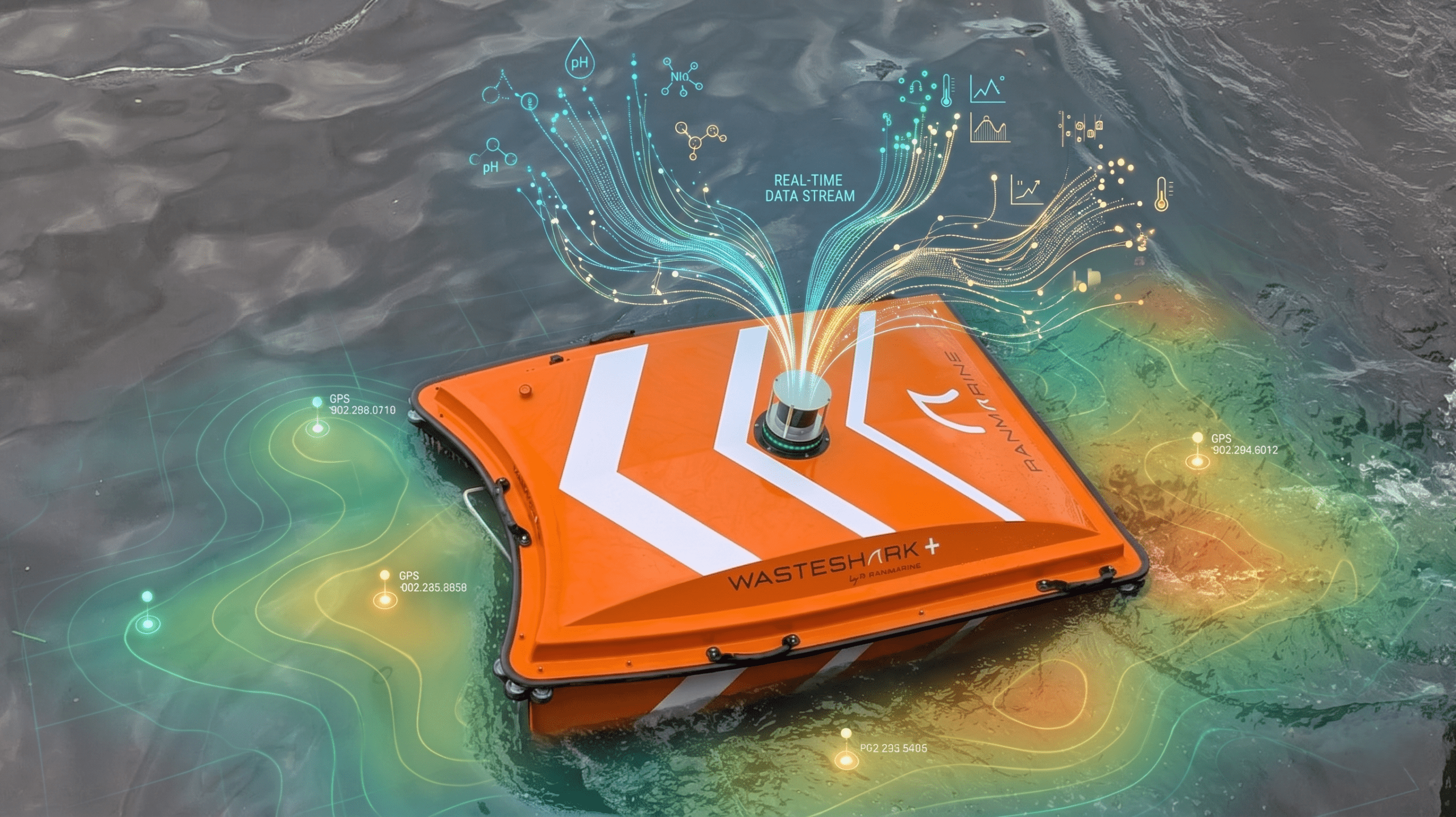
One of the biggest hurdles in this digital revolution is the fact that water moves. A stationary sensor on a pier only knows what is happening in its immediate vicinity. To truly understand a waterway and identify the source of a pollution spike, you need the ability to map it. This is where the industry is shifting, moving away from static data points towards dynamic heat maps that track specific “chemical fingerprints” directly to their source.
How RanMarine is Answering the Call
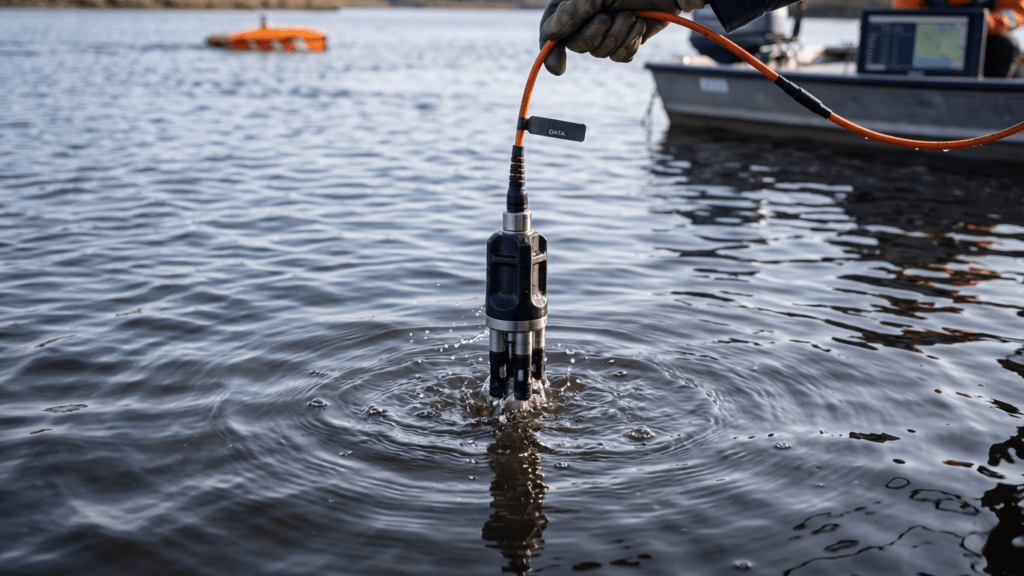
At RanMarine, we designed our technology for precisely this moment. Our autonomous vessels, such as the WasteShark, serve as mobile IoT platforms that bridge the gap between physical clean-up and high-level digital evidence. Our vessels are engineered to carry an array of class-leading sensors that allow authorities to target the exact indicators the EU is now prioritising.
1. Detecting the “Red Flags” of Ecological Collapse
Through the integration of advanced probes, our vessels can move through a harbour or canal to prove the presence of:
- Chlorophyll a & Blue-Green Algae (BGA): These are the critical indicators for the EU’s new “Effect-Based Monitoring.” By detecting these in real time, we can predict and prove the onset of toxic blooms before they devastate local ecosystems.
- Crude & Refined Oil: This aligns directly with the EU’s “Zero Pollution” mandate for ports. Our vessels can identify oil presence with high precision, providing the evidence needed for immediate spill response.
2. Identifying Resource Leakage in the Circular Economy
The EU no longer views runoff as just “waste.” In a circular economy, nutrients like Nitrates and Ammonium are valuable resources. When a WasteShark detects a nitrate spike, it is not just flagging pollution; it is signalling a “resource leakage” that the EU wants to stop and capture for reuse. We turn the act of monitoring into a tool for economic recovery.
3. Using Proxies for the “Invisible” Threat
While the EU’s May 2026 mandates require closer monitoring of microplastics, these particles are notoriously difficult to sense in motion. However, by measuring Turbidity and CDOM/FDOM (Coloured Dissolved Organic Matter), our vessels provide a vital “proxy” for organic loading. These sensors measure the “cloudiness” and organic matter that often carries pollutants and microplastics, providing a roadmap for where physical intervention is most needed.
4. Mobility is the Mission
By utilising an autonomous and floating platform, RanMarine provides a level of situational awareness that stationary sensors simply cannot match. As our vessels patrol, they create a comprehensive digital twin of the water’s health. We are not just providing a single data point; we are providing the definitive evidence required for a Water-Smart Society.