‘Robot shark’ from startup RanMarine collects waste from the canals of Zaandam: Rotterdam company is aiming for ’round of millions’ to conquer the US
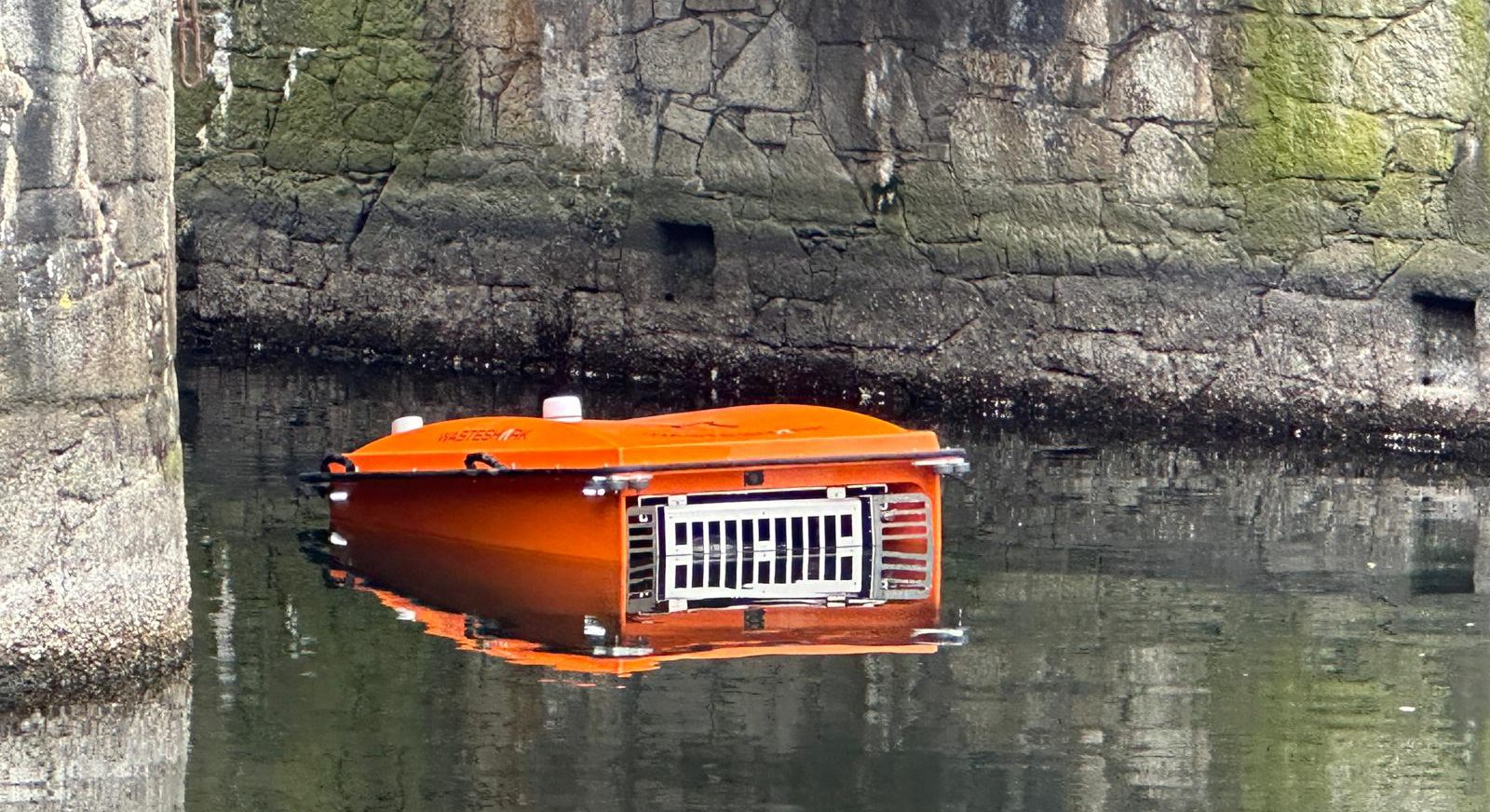
Frequent visitors to the Zaandam city center will have already seen him: the so-called ‘Veulvreter’. Here, in the Gedempte Gracht, a small white boat sails once a week with an insatiable hunger for waste. Floating cans, chip trays, PET bottles: this mini-catamaran eats everything that we humans would rather lose than be rich.
The ‘Veulvreter’, as it is called in Zaandam, is actually called WasteShark. It is a creation of the Rotterdam company RanMarine (in full: RanMarine Technology). After a charge, the electrically powered boat can search the water for six hours for waste, according to a pre-programmed zigzagging pattern. As a result, the ‘robot shark’ can remove up to 500 kilograms of waste from the water per day, according to the startup.
Zaanstad was the second Dutch municipality to launch the WasteShark in December, after Dordrecht had previously conducted a successful trial with the device. It saves time for employees of the municipal waste service in Zaandam, as they no longer have to fiddle with fishing nets to retrieve discarded cans from the canal.
Esther Lokhorst stands bent over one of her robot sharks in an old industrial building on a business park in the Rotterdam industrial area Nieuw Methesse. The interior can be described as a potpourri of wires and chips. A team of four young men works on the hardware and Lokhorst, as operational director, keeps an eye on things.
A little further in the open air we find a small water bath, which was installed here by RanMarine. Even though the sun is shining seductively this Wednesday afternoon, people are not supposed to take a dip in it. The only bather allowed is the WasteShark, which Lokhorst and her team test here after every refinement of the technique.
RanMarine’s WasteShark makes a tour of the test pool in Rotterdam. In the background operational director Esther Lokhorst (left) and founder Richard Hardiman.Photo: Business Insider Netherlands/Jelmer Luimstra
Sensor-equipped drones
The boats are in fact drones equipped with GPS and two sensors. The sensors measure the water quality and depth and forward this information to an online portal of RanMarine. “If, for example, dredging is required, customers immediately gain insight into how deep the soil is,” says Lokhorst.
Her company supplies floating drones that work completely autonomously, but also robot boats that you can control remotely. The robot boat can not only grab plastic waste from the water, but also duckweed. The company is currently investigating in Helsinki whether it is also possible to rid the water of blue-green algae.
No, the robot sharks are not a danger to passing birds, Lokhorst says when asked when we take a seat in a deserted, industrial-looking company canteen. “The boats only sail three kilometers per hour,” says the director. “In our five years of existence, we have never caught a bird or even a fish.”
RanMarine has so far sold more than fifty of these types of boats to 25 customers, says Lokhorst. Many of those customers come from abroad. For example, robot boats from the startup are sailing in the port of Houston, in Dallas and in Plymouth in the UK. The company has customers worldwide: from South Africa to South Korea and from Nigeria to Ireland.
Typical customers are government institutions and water boards, but theme parks are also part of the regular customer base. For example, RanMarine supplies its robot boats to Disney and Universal parks in Florida, among others. “America is a very important market for us,” says Lokhorst. “We are therefore now setting up an American division. We already have employees in the US and want to expand considerably.”
In time, this should result in an American office, says Lokhorst when asked. When, she can’t say yet. “For the time being, we will keep production and development here in Rotterdam. If we scale up considerably in the US, we will also start an assembly department there.”
In the Netherlands, Zaandam and Dordrecht are currently the only municipalities to which RanMarine supplies its aquadrones. It sometimes turns out to be quite complicated to hook up with municipalities. “The municipality is not always responsible for cleaning up waste. Some municipalities outsource this to cleaning companies.”
Lokhorst does state that its sales team is busy hooking up more Dutch municipalities. RanMarine even expects to start a project in the Wadden Sea soon.
Operations director Esther Lokhorst (left) of RanMarine joined the company in 2017. To the right of its founder Richard Hardiman. Business Insider Netherlands/ Jelmer Luimstra
Film WALL-E provided inspiration
Lokhorst is not the founder of RanMarine. The company was founded in 2016 by South African Richard Hardiman, who worked as a radio DJ and journalist in a previous life.
Hardiman came up with the idea of the garbage-eating robot shark when he was sitting on a terrace in Cape Town and saw people using a net to remove dirt from the water. There had to be an easier way, Hardiman thought. His mind wandered off to the film WALL-E, in which the leading role is played by a futuristic robot that collects and compresses waste.
A little further on, the bearded man in his forties is having a video call with a colleague from the US. Hardiman has been living in the Netherlands since 2020, where he saw more opportunities to succeed with his startup plan than in South Africa. He participated in a growth program of PortXL, a company affiliated with the port of Rotterdam, for which Lokhorst worked. She joined the then fledgling startup in 2017.
Now, six years later, the company already employs 23 people. RanMarine has been profitable since 2021, according to Lokhorst. The company does not share profit and turnover figures. From the most recent summary profit and loss account that the company filed with the Chamber of Commerce (KvK), it can be concluded that RamMarine closed 2021 with a positive equity capital of more than 7 tons.
RanMarine raised an unknown amount of growth financing twice in its existence. According to Lokhorst, a “serious round of millions” is planned for April. With the upcoming millions, RanMarine hopes to be able to grow faster, especially in the US. The company is also investing in the development of larger aquadrones and robot boats that can extract oil from the water.
Rapid growth also seems to be necessary. In 2019, RanMarine was the first party to market an aquadrone. The market is now busier, with competitors in France, China and the US. Nevertheless, Lokhorst does not see a major threat in this: “The market is large enough for several parties. The positive thing about more competition is that this technique will become better known as a way to remove rubbish from the water.”
Article written by Jelmer Luimstra of Business Insider Nederland
Feb 23, 2023