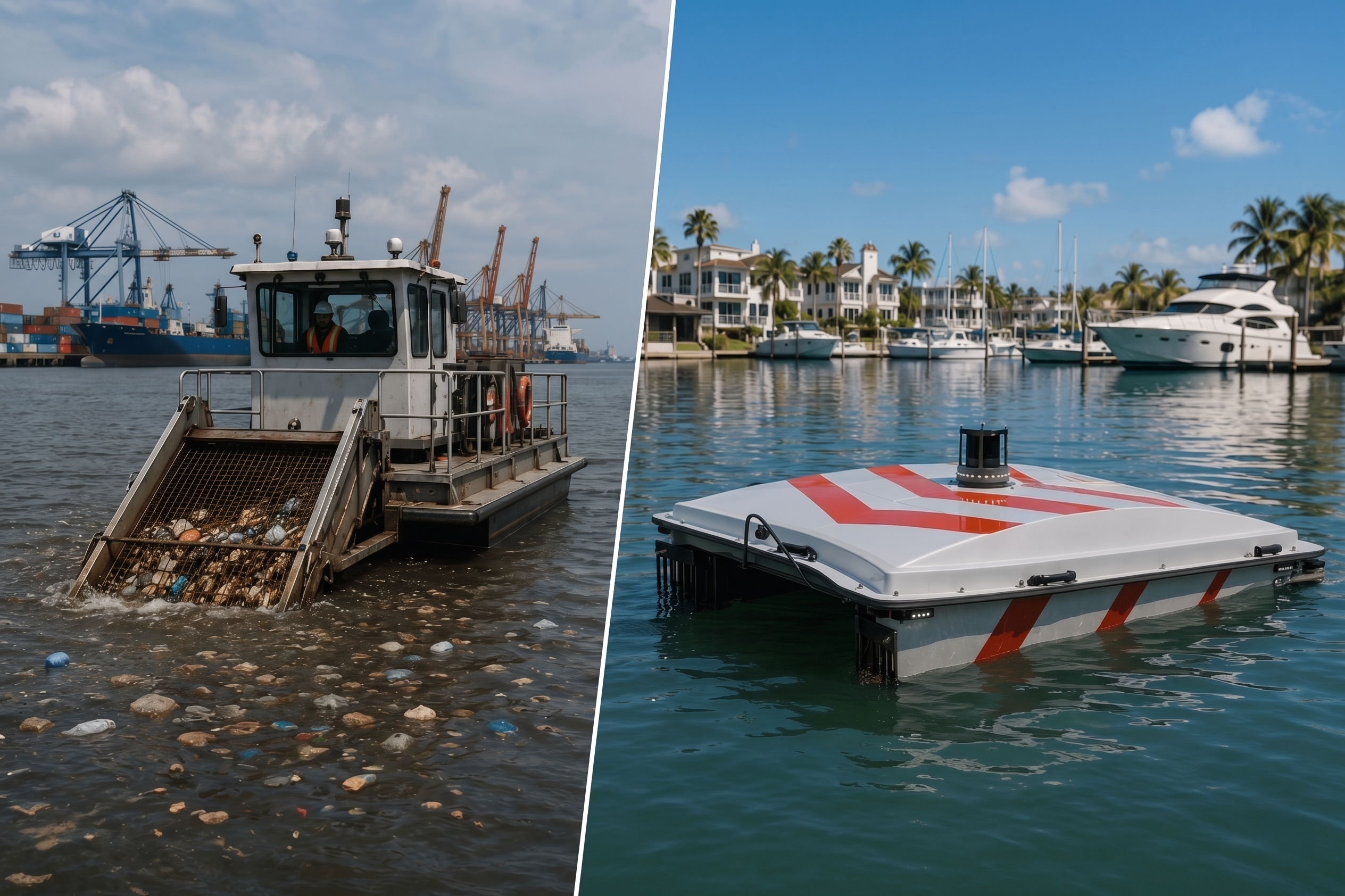
Keeping marinas, ports, canals, and industrial waterfronts clean has traditionally meant deploying manual clean-up crews or using conventional skimmer boats. But with autonomous marine robotics becoming more capable and affordable, operators are increasingly asking a practical question:
Is a traditional skimmer boat still the best solution, or is an autonomous electric alternative the smarter investment?
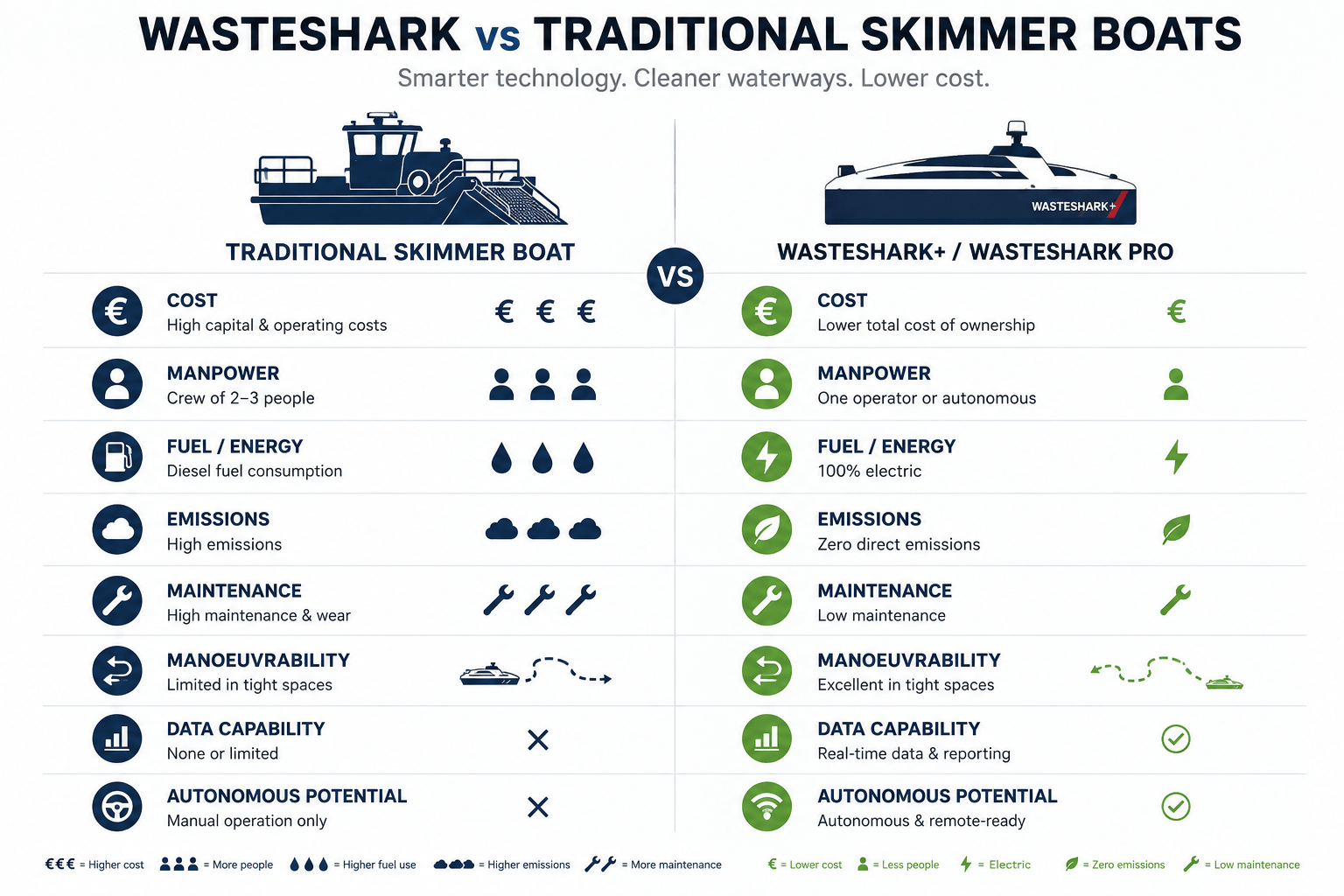
The answer depends on the use case. Here’s a practical comparison.
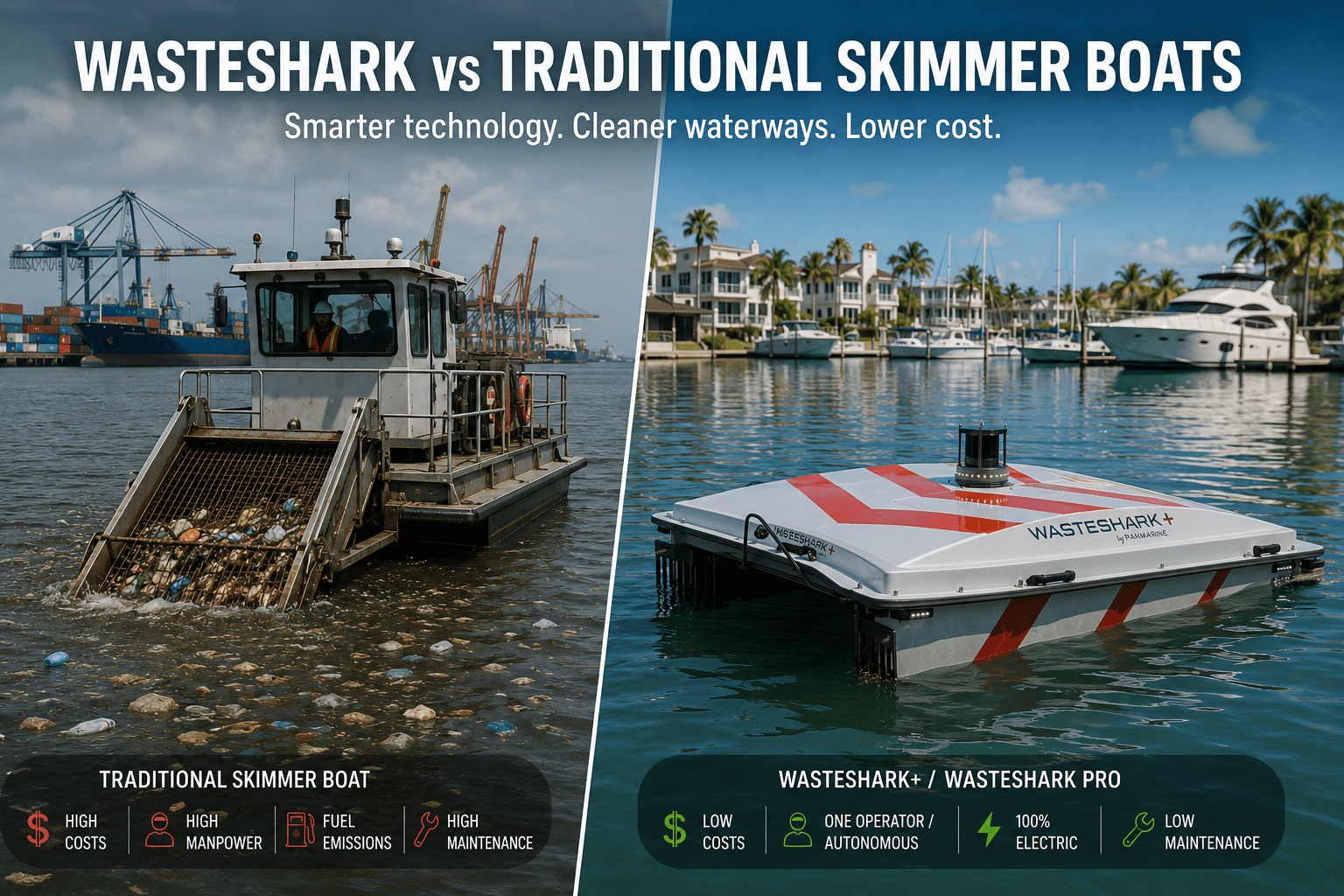
Acquisition Cost: Capital Investment Comparison
Traditional skimmer boats vary widely in price depending on size, payload, and intended application.
Larger industrial skimmer boats designed for trash and commercial debris removal can require significant capital investment, often reaching well into six figures, with some highly specialised systems costing substantially more.
Autonomous electric cleanup platforms such as the WasteShark family operate in a different category. Rather than replacing every large workboat, they are designed for recurring maintenance tasks, lighter debris collection, and routine water monitoring.
Best fit:
- Traditional skimmer boats: Heavy-duty industrial operations, very large-scale trash debris volumes
- WasteShark platforms: Daily maintenance, marinas, ports, canals, campuses, municipal waterways
Manpower Requirements
A conventional skimmer boat typically requires:
- trained operator
- deployment logistics
- docking access
- fuel management
- maintenance scheduling
For recurring clean-up operations, labour quickly becomes a major cost driver.
Autonomous or remotely operated robotic systems significantly reduce labour intensity.
WasteShark platforms can be deployed by a single operator, while autonomous models can repeat programmed routes with minimal supervision.
This can be especially attractive where cleanup needs to happen daily or multiple times per week.
Advantage:
WasteShark+
Emissions & Sustainability
Traditional skimmer boats are commonly diesel-powered.
That means:
- fuel costs
- emissions
- engine servicing
- noise pollution
- ESG contradictions for sustainability-led organisations
Electric robotic platforms offer:
- zero direct emissions
- quieter operation
- lower visible environmental footprint
- cleaner ESG storytelling
For municipalities, corporate campuses, resorts, and environmentally conscious operators, this matters.
Advantage:
WasteShark +
Maintenance & Operational Complexity
Traditional vessels introduce familiar marine maintenance requirements:
- engines
- pumps
- fuel systems
- hull servicing
- marina storage
- scheduled servicing
Autonomous electric systems replace many of those with:
- battery management
- software updates
- sensor maintenance (if equipped)
- propulsion inspection
Complexity shifts from mechanical-heavy to technology-heavy.
For many operators, the reduced maintenance burden is attractive.
Advantage:
Depends on operational model, but often WasteShark+ for recurring lighter-duty deployments.
Manoeuvrability in Tight Spaces
Traditional skimmer boats excel in open operational environments.
But marinas, canals, docks, pontoons, and confined urban waterways create a different challenge.
Robotic platforms are specifically designed for tighter navigation environments where precision matters.
This makes them especially effective for:
- marina basins
- hotel lagoons
- urban canals
- yacht club docks
- confined or busy harbour edges
Advantage:
WasteShark+
Ports vs Marinas: Different Operational Needs
Marinas
Marinas typically need:
- frequent floating debris removal
- guest-facing cleanliness
- quiet operation
- limited staffing burden
- manoeuvrability
Autonomous or compact electric platforms are often an excellent fit.
Ports
Ports face larger debris loads, more vessel traffic, and heavier operational requirements.
In some ports, traditional skimmer vessels remain appropriate.
In others, robotic systems complement existing maintenance fleets by handling routine floating debris and inspection work more efficiently.
Best conclusion:
- Marinas: Strong fit for robotic systems
- Large industrial ports: Hybrid approach often makes sense
Environmental Data Capability
This is where the comparison changes dramatically.
Traditional skimmer boats are generally trash & debris removal tools.
Autonomous robotic platforms can also support environmental monitoring, depending on configuration.
Potential applications:
- dissolved oxygen monitoring
- pH measurement
- effluent monitoring
- turbidity monitoring
- conductivity tracking
- temperature mapping
- hydrocarbon detection
- environmental reporting support
This creates additional use cases beyond debris removal.
Advantage:
WasteShark+ and the autonomous WasteShark+ Pro
Autonomous Potential
Traditional skimmer boats remain manually operated assets.
Autonomous marine robotics introduce:
- repeatable programmed routes
- collision avoidance
- reduced operator burden
- recurring autonomous missions
- integration with fleet monitoring platforms
This becomes increasingly valuable when waterway maintenance needs to scale.
Advantage:
WasteShark+ Pro autonomous system
Final Verdict
Traditional skimmer boats remain highly relevant for:
- heavy-duty industrial cleanup
- very large trash & debris payload requirements
Autonomous electric marine robotics offer compelling advantages for:
- recurring debris maintenance
- marinas
- municipal waterways
- environmental monitoring
- sustainability-driven operations
- lower labour deployment models
For many operators, the question is not either/or.
It is increasingly:
Which combination delivers the most efficient waterway management strategy?
Want to Explore an Autonomous Alternative?
If you’re evaluating floating debris management, marina maintenance, or environmental monitoring solutions, our team can help assess whether an autonomous electric platform fits your operational needs.