Sharks have been portrayed as vicious killers and predators to be feared. This is in part thanks to the many Hollywood films dedicated to the fear genre. While the films might make for great entertainment, they have done little to promote sharks in a positive light.
While sharks are indeed scary-looking creatures, they are not as deadly and lethal as fear-mongers make them out to be. In fact, most sharks are pretty harmless and most people will never even encounter a shark in their lifetime.
Sharks have been roaming the oceans for more than 400 million years and their presence keeps the marine world in balance. They mature very slowly and breed few offspring, with the females reaching reproductive maturity at around 12 to 18 years of age. The exception to that is the Great White shark, who only reaches reproductive maturity at around 33 years.
How do Sharks balance the ocean’s ecosystem?
In the ocean, sharks are at the top of the food chain. Known as Apex Predators, they help keep fish populations from overpopulating, and they preserve marine biodiversity. Thanks to the sharks, slow and unhealthy fish are gobbled up, leaving room for the healthy fish to thrive. Not only does this contribute to an overall healthy marine ecosystem, it also creates abundant fish for humans to consume.
Algae are much-needed plants in the marine ecosystem, essentially supplying marine life with energy through their process of photosynthesis. If algae-eating fish numbers were to decline, the entire ecosystem would be in big trouble. With an overproduction of algae, the reef system would become overwhelmed and would not be able to recover from bleaching and other reef disturbances. Guess who keeps these algae-eating fish numbers under control? You guessed it.
How do sharks benefit humans?
Not only do they keep the marine ecosystem balanced, but they provide humans with incredible healing inspiration too. Marine scientists have been puzzled for years as to why sharks rarely become ill as other marine species do. This has led them to examine shark tissues that appear to have anticoagulant and antibacterial properties that can be used to treat certain medical conditions in humans. Scientists have now designed a coating used in hospitals to treat bacterial infections. Sharklet, is the world’s first technology to inhibit bacterial growth through its pattern alone. It draws inspiration from the shape and pattern of the dermal denticles of shark skin and contains no toxins or chemicals.
How do sharks help to control climate change?
We all know that carbon contributes to climate change. By feeding on the dead matter at the bottom of the ocean, sharks actually help to move carbon through the ocean.
Sharks are about 10 – 15 percent carbon. If they are killed and removed from the ocean, they actually release that carbon into the atmosphere. If sharks are left to die naturally, they sink to the bottom of the ocean and their carbon is safely sequestered for millions of years.
If sharks were to completely disappear it would create a devastating chain reaction with far-reaching consequences to the human race. Our entire marine ecosystems would collapse and everything from coral reefs, food security, and climate change would be affected.
What is killing our sharks?
When fishermen run out of fish, which often happens in overfished areas, they have to literally cast their nets further and wider. Commercial fishing often employs the longlining method, meaning they cast lines with baited hooks attached at intervals by means of branch lines called snoods. This method easily snags non-targeted marine life like sharks (known as bycatch). That means that a large number of sharks are accidentally caught.
You might have heard about shark fin soup – a delicacy in China and Vietnam. Hunters catch sharks and literally slice off their dorsal fins, then throw them back into the ocean to sink to the bottom as the sharks are unable to swim without their dorsal fins. Sometimes their bodies are sold on to be harvested for making things like lubricants and leathers. The Hong Kong market alone handles more than 3000 tonnes of shark fins annually and the “best” fins sell for more than $400 each. Many of the sharks killed for their fins haven’t even reached reproductive age yet. A recent study on the genetic analysis of fins at the Hong Kong market revealed that about one-third of the fins actually belonged to threatened species.
Shark specialists estimate that between 73 million and 100 million sharks are killed for their fins each year. That equates to about 11,000 sharks killed every hour or 3 sharks every second.
How do sharks inspire us?
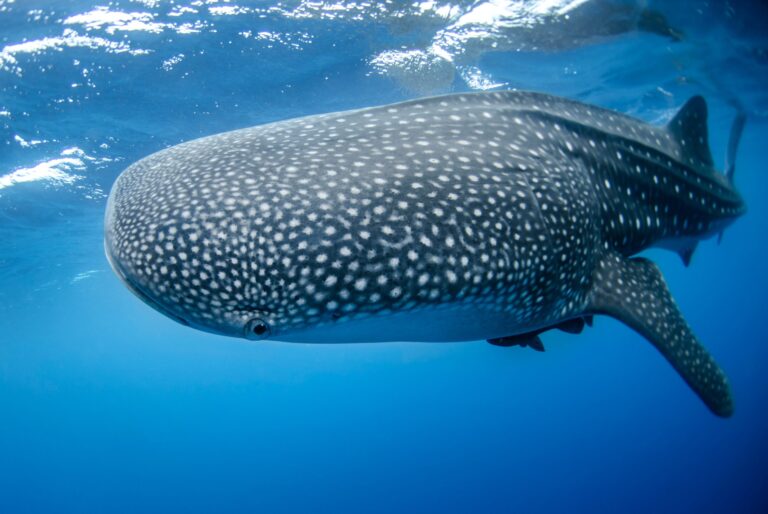
Whale Sharks are one of the largest creatures on earth, and probably the most docile of all sharks. Whale Sharks are cold-blooded, warm water fish and they live in temperate and tropical seas near the equator. They migrate incredible distances in search of food and are one of the ocean’s biggest binge eaters. They can weigh more than 30 tonnes and be larger than a city bus in length. But like all sharks, they are endangered.
RanMarine Technology created an aqua drone that was designed to clean waterways, canals, rivers, harbours, and ports by removing floating pollution and biomass. Their design was inspired by the Whale Shark and is aptly named WasteShark. The autonomous surface vessel (ASV) weighs 72 kgs and is 157 cm in length. WasteShark moves through the water at a maximum speed of 3 km/hr and literally gobbles up waste. Moreover, the ASV is able to measure and monitor the quality of water.
It collects data that is geotagged and timestamped to give an accurate picture of the water quality health within an ecosystem. This allows one to accurately monitor the quality of the water to help verify compliance with pollution regulations, identify potential contaminants early to minimize the impact on the environment, and make the water safe.
Sharks literally take care of the oceans and their rapidly declining populations are threatening our very existence on this planet. Without them, the entire seafood chain would collapse. Our very survival depends on sharks surviving and thriving.
How are you contributing to the decline or protection of these precious marine animals?