Floating drones inspired by whale sharks and four-wheeled robots are the latest inventions in an attempt to address plastic pollution, Bloomberg reports.
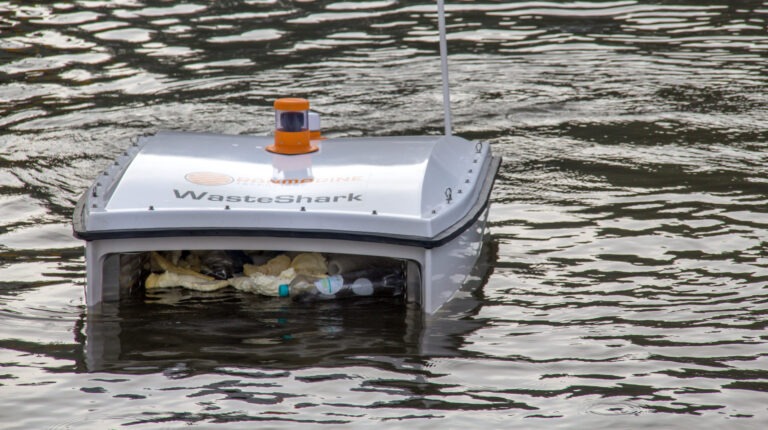
RanMarine Technology, an organization based in Rotterdam, has developed what they call a ‘WasteShark’ that collects waste through a wide opening that mimics a whale shark. The WasteShark is an autonomous surface vessel, this means that it requires no supervision as it can be left in the chosen water body, with a preset route, using GPS to navigate and then return home.
The organisation claims that the WasteShark can collect up to 500kg of waste per day. There is also a four-wheeled version, a beachbot, that collects small litter like cigarette butts and bottle caps. You can view the WasteShark in action on the canals of Holland below.
A recent publication in Nature Sustainability provided a comprehensive analysis of the solutions to tackle marine litter. Even though policies are being created to address plastic pollution, such as the decision taken by Tanzania in 2019 to ban all plastic bags in the country, the publication brings up the issue of the existing plastic in our oceans.
The research was led by biologist Nikoleta Bellou who commented that “the oceans have already been polluted to such an extent, simultaneous to all the actions needed to reduce pollution at the source”.
Plastics pollution is piling up faster than initiatives to correct it, with calculations indicating that it will take about 100 years to retrieve 5% of plastic in the oceans
As much as 91 million tons have entered the world’s oceans between 1980 and 2015, with more than 8 million tons entering the oceans every year. What we see on the surface is only 5% of the plastic in the oceans. plastic has contaminated the darkest parts of the Mariana trench and is so widespread that it is estimated that by 2050, 99% of seabirds would have ingested plastic.

The worsening plastic pollution on the planet seems as if our reality is coming to represent Pixar’s 2008 film, Wall-E, where the earth so despoiled that it is no longer inhabitable that humans are living in some kind of space-ark while a robot is left to clean up the waste. But this is just a movie…

To prevent this dystopia, policies to avoid disincentive plastic production and encourage a circular economy as well as public education on the harms of plastic are needed in collaboration with technofixes such as the WasteShark. In 2010, South Africa ranked 11th on the list of the worst offenders regarding plastic pollution in the ocean. South Africa only recycles 16% of its plastic, where the rest end up in landfills where they can easily blow into rivers and eventually, the ocean.
Article by Getaway