Florida’s Red Tides Are Getting Worse

A task force appointed by Gov. Ron DeSantis is calling for research and investment in mitigation. Environmentalists say the real fix is cracking down on polluters.

By Aman Azhar 
January 19, 2022

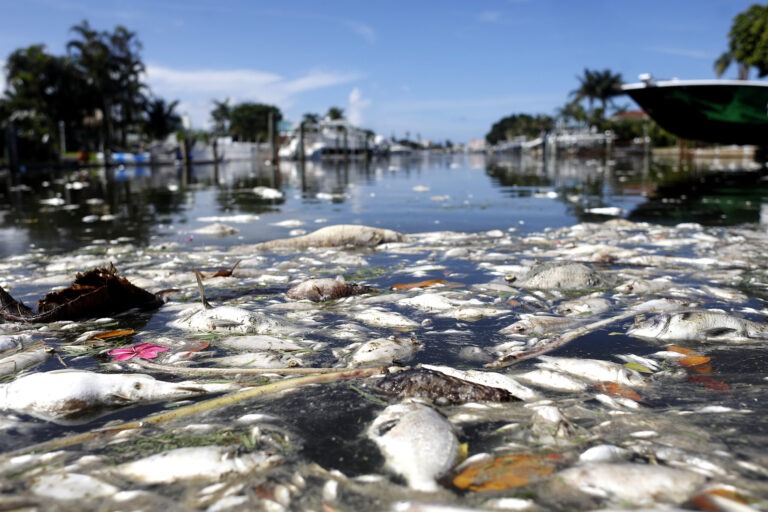
Thousands of dead fish float in the Boca Ciega Bay located near the mouth of Madeira Beach on July 21, 2021 in Madeira Beach, Florida. Credit: Octavio Jones/Getty Images

The blooms are caused by high concentrations of a plant-like microscopic organism known as Karenia brevis fed by nutrients in runoff from stormwater, agricultural lands and wastewater treatment plants. A key stimulant is phosphorus from fertilizer used on farms and ranches in the Kissimmee River Basin, which forms the headwaters of the Everglades and drains into Lake Okeechobee, which in turn reaches the coasts through rivers and man-made canals.

The algal blooms, which at one point in 2018 covered 90 percent of the lake’s surface, can have devastating impacts on ecological resources and communities, causing respiratory and eye irritation in humans and “widespread reports of fish, sea turtle, marine mammal, and other wildlife mortalities,” according to the Florida Harmful Algal Bloom Task Force.

Released on Jan. 10, the task force’s report recommends more research to determine the causes of red tides, more investment in mitigation technologies and continued work under the Clean Waterways Act of 2020.

What the task force described as a “prolonged 2017-2019 red tide event” began with an algal bloom on Lake Okeechobee and resulted in “estimated total losses of nearly $1 billion in revenue and an additional loss of $178 million in tax revenue in 23 Gulf coast counties.”

The impacts of climate change, which the task force said “may be impossible to change,” contribute to the algal blooms “through a complex variety of mechanisms including warmer water temperatures, changes in salinity, changes in rainfall patterns… changes in coastal upwelling, and sea level rise.”

Read full article by Inside Climate News

more news

Flocean in the Deep: The Dawn of Subsea Desalination

By placing their desalination units on the seafloor at depths of 400 to 600 meters, Flocean uses the ocean’s own weight to push seawater through reverse-osmosis membranes.

IMO Sharpens Strategy for Zero Plastic Pollution by 2030

The International Maritime Organization (IMO) has recently reinforced its commitment to eliminating marine plastic litter from the shipping sector.

The Plastic That Vanishes: A New “Plant-Based” Breakthrough for Our Oceans

A new material designed to literally dissolve in seawater within hours

WasteShark Launches in Breda’s Historic Canals

The WasteShark deployment in Breda represents more than traditional waste collection.

Ready to see our shark in action?

Get in touch for a live virtual demo or a quote.
Our team is ready to help.

Trusted by Port Authorities and Facilities Management Teams across the globe

Proven technology. Global Impact.

Don’t just take our word for it. Explore our case studies to see how our customers use data-driven autonomy to create cleaner, safer waters around the world.

PortsToronto

PortsToronto’s Trash Trapping Programme added WasteSharks to supplement their harbour cleanup efforts, removing plastic debris from Toronto harbour

BIC Consolidated

Maintaining pristine water quality across vast, debris-prone commercial waterfronts using traditional methods was labour-intensive, inefficient and lacked audit data

Gemeente Zaanstad

The WasteShark collects floating litter and removes rapidly growing duckweed in urban canals, keeping Zaanstad an attractive city

Our Technology

Advanced robotics designed to clean, monitor, and restore marine environments.

WasteShark

Manual & Accessible

The essential tool for calm waters

WasteShark +

Built for Professionals

Power and speed for marinas & ports

WasteShark + Pro

Intelligent Autonomy

LiDAR guided cleaning with data capabilities

CyanoShark

Harmful Algae Solution

Specialized filtration to remove harmful blooms and biomass

MegaShark

Industrial Capacity

Heavy-duty waste removal for ports and large waterways

RanMarine Connect

Unified Data Platform

Real-time water quality monitoring and fleet management

Schedule your demo

Book your 30-minute live demo with a RanMarine specialist.
(Subject to location and availability)

Cleaner waters, delivered to your inbox.

Join 2,000+ subscribers receiving the latest updates on marine technology and sustainability.

Submit a Support Ticket