In 2014 Planet Earth produced 311 million tons of new plastic. 32% of it leaked into fragile ecosystems. 10-20 million tons reached the ocean, causing US$13 billion of environmental damage. California, Oregon and Washington alone spend $500 million annually clearing trash from their Pacific coastline.
WATER AND AIR, THE TWO ESSENTIAL
FLUIDS ON WHICH ALL LIFE DEPENDS,
HAVE BECOME GLOBAL GARBAGE CANS.
Jacques-Yves Cousteau
In some places, plastic microbeads outnumber plankton (a critical source of our oceanic food chain) by 26:1. The new generation of “biodegradable” plastics won’t solve this problem, because the conditions required for this to happen just do not exist in the ocean.
THE SEA, THOUGH CHANGED IN A
SINISTER WAY, WILL CONTINUE TO EXIST:
THE THREAT IS RATHER TO LIFE ITSELF.
Rachel Carson
The bitter commercial reality is that once trash reaches the open ocean it’s everybody’s problem… and nobody’s accountability. We need to stop trash reaching the ocean in the first place. But how?
The systemic, sustainable answer is four-dimensional.
We need to change human behavior, especially the pattern of “consume and dispose”.
We need to become more efficient producers; not “producing more, quicker”, but using better input materials for production, materials that can be completely recycled or perfectly decomposed at zero harm to the ecosystem.
We need to extract the trash that is already in the deep ocean.
We need to catch trash that is close to land before it is carried out to ocean by tide, current and wind.
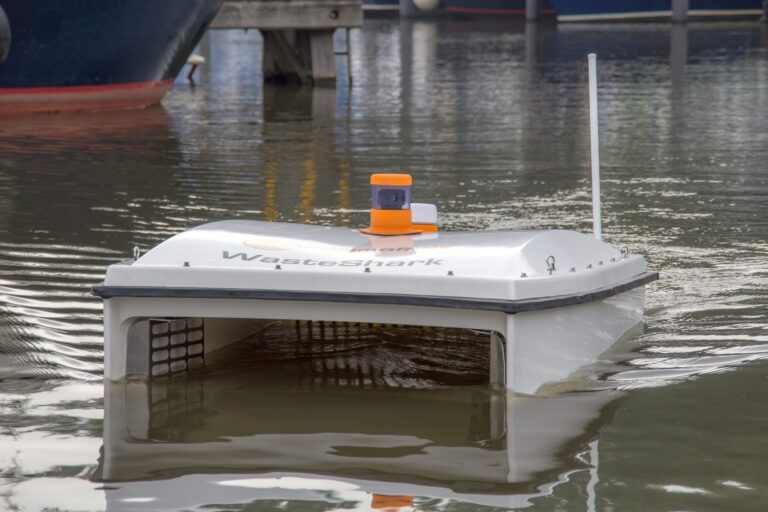
Points 1-3 above are long-term change projects. Point 4 is a quick win; an opportunity to make instant improvement. Autonomous drones offer a low-cost, high-effectiveness approach to catching marine litter. A drone can operate 24/7 (trash does not keep regular working hours) in hostile conditions, and can do work that living beings cannot, or should not be compelled to, do. When your drone is also a learning machine, then a team of drones becomes a responsive, self-organizing swarm – an autonomous net to patrol your inland waters and catch waste before it harms the ocean ecosystem.
WE KNOW THAT WHEN WE PROTECT OUR
OCEANS, WE’RE PROTECTING OUR
FUTURE.
Bill Clinton
This is the future: autonomous drones clearing marine litter, while humans – and all species – just live, thrive and have fun! Technology at work, serving the sea.
OLIVER CUNNINGHAM is a sci-fi geek and futurist. He makes drones that swim around cities, eating marine plastic and keeping our seas beautiful.
Sources: Ellen MacArthur Foundation at the 2016 World Economic Forum; the United Nations; The Guardian; The Telegraph; www.plasticoceans.org