RanMarine has created the world’s first autonomous marine robot. Utilizing drone technology, it can collect up to 500 kg of plastic waste and destructive biomass each day, harmoniously clearing up and monitoring our waters.
As WH Auden once said, “Thousands have lived without love, not one without water.” Vital to all life on earth, our biosphere and everything living upon it would perish without it.
Despite water’s importance and our dependence on it, our continued pollution of it is putting this crucial resource at risk — our oceans are plagued by plastic to the tune of approximately 5.2 trillion macro and micro pieces, killing 1 million seabirds and 100,000 marine animals each year; toxic algal blooms are becoming more frequent and deadly, with 400 marine dead zones worldwide; and contaminated water is killing an estimated 1.2 million people each year.
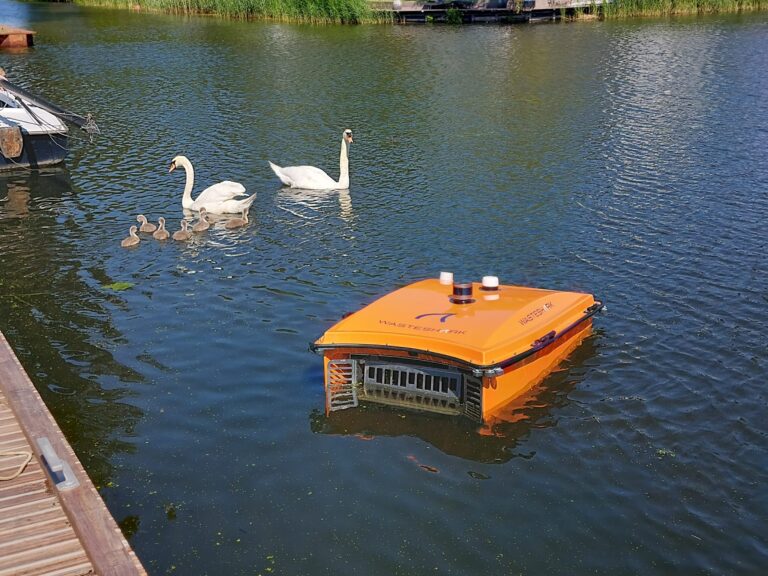
In an attempt to address the severity of the situation, Dutch tech startup RanMarine is on a mission to restore the marine environment to its natural state by cleaning up our waters. It has developed the world’s first marine robot specifically designed to eat marine waste and collect data on our polluted waterways. Inspired by the way in which whale sharks suck in food and filter out water, the company’s WasteShark autonomous surface vessel (ASV) is “taking a bite out of water pollution.”
The zero-emission WasteSharks use drone technology to vacuum up plastic waste and biomass. Each one can collect up to 500 kg of waste per day, with a battery capacity of 8 hours on one charge. They’re designed to be efficient, unobtrusive and harmonious with the environment.
“We are particularly proud of the fact that zero carbon is emitted while using the WasteShark,” RanMarine founder and CEO Richard Hardiman told Sustainable Brands®. “With batteries that can be charged from the local grid or powered by solar storage systems, the WasteShark leaves no oil slicks, emits no toxic fumes and is unobtrusive on the water. These attributes ensure that it is the perfect solution for working in environments where wildlife is present — it allows you to safely collect harmful biomass and waste remotely from the shore or quayside.”
The WasteSharks’ operational routes are predetermined by the user. They carry out these routes via GPS navigation and can return home at the end of their ‘shift.’ The manual WasteSharks are essentially drones that travel through water, rather than air. They use the same technology and camera systems as a typical flying drone — including a hand-held controller. The automated drones, on the other hand, use ROS software to manage the complexity of being autonomous and having to “think for themselves” whilst deployed.
Although a mission plan is set out by the user on our web portal, RanMarineConnect, the Sharks have to be able to navigate and avoid obstacles that may not have been there at the time of planning; typically these include moving boats, moored vessels or unplanned obstacles,” Hardiman explains. “Here, we use our own internal software to navigate the drone safely to make sure the WasteShark can still do its job without endangering or colliding with other vessels.”
Data collected from the WasteSharks is geo-tagged and time-stamped, providing an accurate picture of the water quality health within an area. This representation helps verify compliance with pollution regulations, identifies potential contaminants early to minimize the impact on the environment and creates cleaner aquatic environments.
Written by Scarlett Buckley and published in Substainable Brands
“The aquatic drones can also be configured with different sensors to help monitor temperature; depth; dissolved oxygen; turbidity; blue-green algae; crude, refined oils and more. Any data collected is immediately available for reporting and analysis through the WasteShark Data Portal,” Hardiman says.
The RanMarineConnect portal allows clients to upload collected data for their own research and analysis. In the future, the RanMarine team is hoping to develop a data-sharing platform between users; but this is still at a conceptual stage.
More than 40 WasteSharks have been deployed across the globe — including in Denmark, Singapore, the UK, US, Australia and South Korea. Some of WasteShark’s clients include well-known theme parks in Orlando; the Port of Houston, Texas; and United Nations projects in Lebanon.
Hardiman says RanMarine will launch a larger WasteShark in the next six months that is capable of removing 1 ton of waste in a single load; he anticipates it being commercially available by the end of the year.
“We are also developing a docking station which houses up to 5 WasteSharks at a time, empties their baskets automatically and recharges them,” he added, “making it a total autonomous solution where humans are only required for oversight.”