By Furhana Husani, Director of Programs and Climate Initiatives – Waterfront Alliance
May 28, 2025
The New York and New Jersey waterways face significant environmental challenges, particularly from plastic pollution, harmful algal blooms, and the accumulation of biomass and other floating debris. These issues threaten marine ecosystems, biodiversity, human health, and economies reliant on clean water.
- Plastic Pollution: A stark example of the problem is the estimate that 165 million pieces of plastic are floating in New York Harbor and nearby waters at any given time. This is part of a global issue where over 171 trillion pieces of plastic are in our oceans, projected to triple by 2040. This plastic debris, including tiny nurdles, breaks down into microplastics and nanoplastics, releasing chemicals that harm marine life and are considered among the world’s top environmental challenges.
- Harmful Algal Blooms (HABs) and Biomass: HABs, caused by cyanobacteria that flourish due to excess nutrients like nitrogen and phosphorus from runoff, are increasingly prevalent. Last summer, over 500 confirmed harmful algal bloom conditions have been reported statewide in New York, affecting dozens of water bodies. HABs can cause health problems for humans and animals, from skin rashes to severe illnesses, leading to beach and swimming area closures for extended periods. Climate change is expected to exacerbate the frequency and intensity of these blooms.
- Oil and Hydrocarbons: Incidental oil spills in areas like ports and marinas, often from land-based runoff or leisure craft, pose a risk to environmental health and can restrict activities like swimming, boating, and fishing.
These challenges underscore the urgent need for effective, environmentally sound methods for pollution removal and waterway restoration in densely populated coastal areas like New York and New Jersey.
RanMarine Technology, a cleantech company specializing in the design, manufacture, and sale of autonomous surface vessels (ASVs), also known as aquatic drones, is focusing its efforts on tackling these critical water pollution problems in New York and New Jersey waterways. Founded in Rotterdam, the Netherlands in 2016, RanMarine’s mission is to empower people, companies, and governments worldwide to restore marine and freshwater environments to their natural state using advanced, zero-emission technologies and data-driven approaches. ASVs are designed to clean the surfaces of waterways, including ports, harbors, marinas, rivers, estuaries, canal systems, lakes, and ponds.
RanMarine’s technology directly addresses these problems. The primary focus of their ASVs is the removal of harmful plastic pollutants, algae/biomass, and oils from water, as well as the treatment of HABs. Core products include:
- WasteShark: An agile, efficient, and emission-free ASV that operates autonomously or via remote control to collect floating plastic debris and biomass.
- MegaShark: A mid-sized vessel (tender boat duality) designed for high-volume waste collection of aquatic waste and biomass. Operated on-deck or via remote control.
- BlueShark: Integrates WasteShark or MegaShark ASVs with a patented, chemical-free system that disrupts and eradicates cyanobacteria (the cause of HABs) in situ, reducing toxicity and nutrients without harming the ecosystem.
- OilShark (in development): Designed as a first responder for incidental petrochemical and/or hydrocarbon spills in specific areas like ports and marinas.
RanMarine vessels are fully electric and operate with zero emissions, minimizing environmental disturbance and noise compared to traditional fossil-fuel methods.
Beyond collecting waste, RanMarine’s ASVs offer additional capabilities, often through partnerships with third parties. While operating, they can collect critical water quality data using various sensors, such as chlorophyll, pH levels, water temperature, salinity, turbidity, and dissolved oxygen. This data can be accessed in near real-time through the RanMarine Connect portal, aiding informed decision-making about water quality. The vessels can also be utilized for tasks like bathymetry in shallow nearshore areas, acoustic telemetry for tracking tagged fish, and visual mapping of the waterfront.
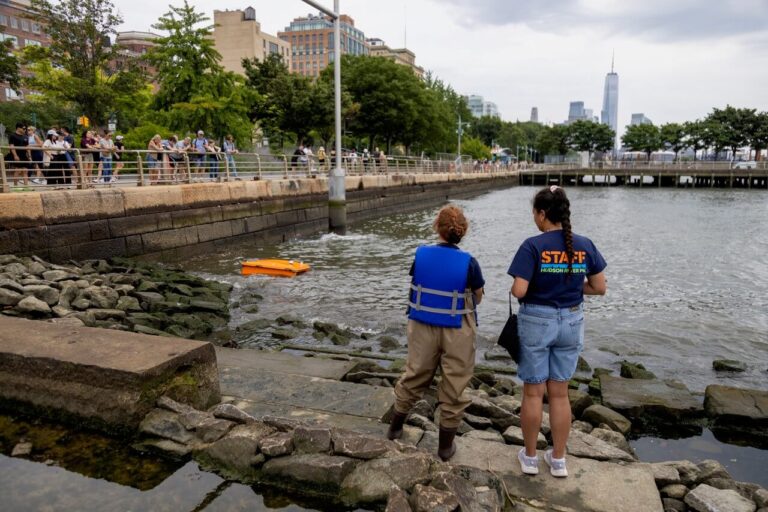
The application of RanMarine ASVs in the New York environment is evidenced through the successful deployment of a WasteShark at the Hudson River Park Trust (HRPT).
Vice President of Estuary & Education at the Hudson River Park Trust (HRPT), Carrie Roble said “Thanks to a grant from the NYS Department of Environmental Conservation, we were able to purchase our WasteShark, affectionally named “Gulp” by our community, approximately two years ago. Gulp now has her own little “shark-shed” at the Gansevoort Peninsula where our team periodically deploys her to help clean plastic hot spots along the bulkhead and park piers. Aside from collecting floating debris, she’s eye catching and an exciting educational tool, prompting conversations between Park users and our River Project team about our important work as park stewards.”
RanMarine’s strategy for deploying its technology, particularly in areas with significant need but limited direct funding like the vast New York and New Jersey shoreline, is heavily focused on innovative partnerships. This is achieved via multi-sector collaborations involving International Governmental Organizations (IGOs), Non-Governmental Organizations (NGOs), various tiers of government, technical partners, operational partners, and ultimately funders including but not limited to as grant makers, corporate sponsors, and environmentally conscious high-net-worth individuals.
A prime example of this approach is the recently launched “Adopt a Shark” initiative in New York City. This initiative will facilitate the deployment of RanMarine ASVs across multiple harbor sites to remove floating plastic debris and biomass and treat HABs in situ. This program will work to engage local communities and involve organizations specializing in the green-blue economy and workforce training.
Through this partnership strategy, RanMarine seeks to make its innovative technology accessible to the areas and organizations that need it most, facilitating crucial clean-up and restoration efforts across the vast and complex waterways of New York and New Jersey and raising awareness about the significant pollution problems they face.
RanMarine is currently seeking to connect with environmental stewards, community leaders, and potential sponsors and funding partners in the New York and New Jersey area who recognize the need for these capabilities in their local waterways and are interested in exploring collaborative deployment opportunities.
For all enquiries regarding partnerships and/or deployment opportunities in the NY/NJ area, please contact Andrew Douglas, email: andrew.douglas@ranmarine.io or cell/WhatsApp: +27 73 790 5946
For further RanMarine related Products and/or Procurement options, availability, or possible Distributorship interests then please contact us on: sales@ranmarine.io / +31 62 6480161

Original article appeared on the Waterfront Alliance website