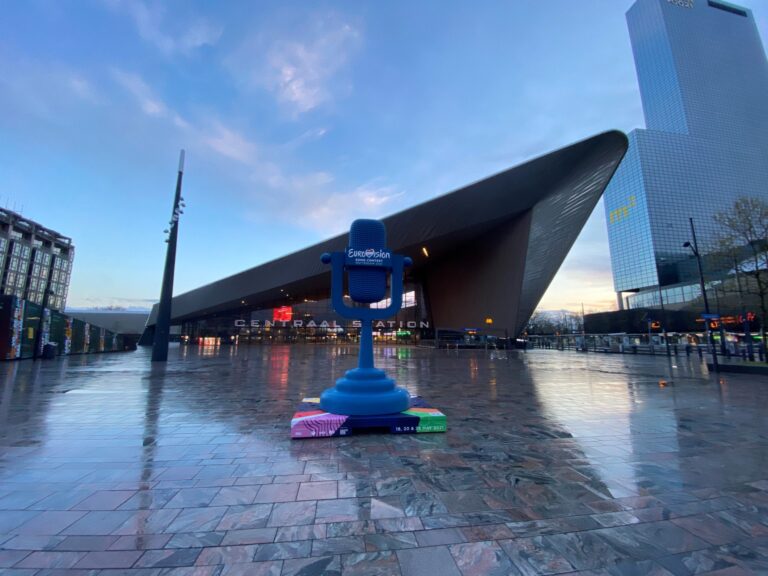
The four-metre high 3D-printed Eurovision trophy made from recycled PET material retrieved from Rotterdam waters is a genuine eye-catcher with a sustainable green footprint. This trophy is a reflection of the city’s character, long driven by the port, innovation and collaboration.
The Rotterdam proving ground
With its rugged port buildings and superb views over the water, the Rotterdam Makers District is the ideal spot for an innovative manufacturing industry. This is where new technologies are thought out, tested and applied. An area still bristling with raw edges, offering the space for businesses and educational institutions to experiment, explore and work together on a clean and sustainable future for the port and the city.
The new technologies here are based upon digitalisation, robotics and continuous fibre additive manufacturing (CFAM), and on the application of new, sustainable energy and materials. All of this results in the Makers District being an exciting proving ground and showcase for the new economy, there for all to see.
Circular production of PET material
Young entrepreneur Wesley dos Santos is the founder of the circular water-recreation business iKapitein. Sailing on his eco-barge through the city of Rotterdam, you will become aware of the diversity that the city has to offer, ranging from historic Delfshaven to the legendary skyline. The electric eco-barge removes litter from the water as it sails along; as the vessel moves forward, its built-in litter-catching system retrieves plastic from the water. If you would prefer to be more active on the water, grab a water bike and pick litter from the water as you move about! Wesley’s mission is to see more electric boats with built-in litter-catchers and sustainable water bikes on the waters of Rotterdam. Active boating and biking, where fun, innovation, awareness and recycling come together.
The collected PET litter from Rotterdam waters is converted into printing material, which Royal 3D uses to create new products with a 3D printer. This is not just any 3D printer, it is a CFAM, purpose-built for Royal 3D by CEAD in Delft. CFAM stands for Continuous Fibre Additive Manufacturing, meaning that glass fibre is continuously added to the printing material. This produces a stronger, more rigid and consequently more sustainable end result. This material forms the basis of the giant Eurovision trophy and is fully recyclable, even if a print should go wrong.

The future of the trophy
The giant trophy will be put up for auction after the Eurovision Song Contest and the proceeds will go to the Dutch company RanMarine, a Rotterdam-based business born out of a desire to improve the welfare of our world’s oceans and waterways.
Their water-cleaning WasteShark can play a significant role in helping to address the scourge of plastics, associated waste and biomass when deployed in appropriate environments. They have been specifically designed for use within ports, harbours, marinas and inland waterways.
They focus on helping to clear plastics and associated trash from waterways before they enter the ocean where their containment and collection becomes far more challenging and costly.
Read more on Rotterdam Make it Happen, visit their website