The United States Embassy in El Salvador yesterday donated three aquatic cleaning drones, known as “Wasteshark“, to the mayor’s office of San Salvador Este, to keep Lake Ilopango free of solid waste and protect the ecosystem there.
by Mariela Quintanilla
June 13, 2024
Reading time: 3 mins read translated from original article as published on https://diarioelsalvador.com/
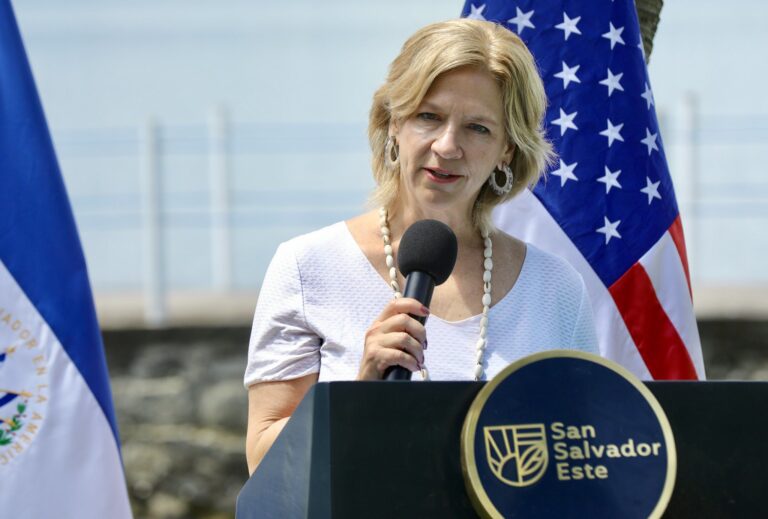
The donation was delivered by Katherine Dueholm, Minister Counselor of the United States of America Embassy, which entails an investment of $172,722, and was received by Mayor José Chicas.

Dignitories incl Minister Counselor of the United States Embassy, Katherine Dueholm, and the mayor of San Salvador Este, José Chicas, were present at the event
Dueholm expressed that this contribution reaffirms the commitment of the United States Government to supporting the country in environmental sustainability and public health.
“We have all seen how garbage accumulates in Lake Ilopango, how plastic bottles and bags float on the surface, and how these remains damage the environment, that is why this donation is so important because the “Wastesharks” that we are donating can navigate the surface of the lake efficiently collecting garbage so that it does not stay there contaminating the water and endangering the health of Salvadorans,” said Dueholm.
The aquatic drones can move manually up to 500 meters in Lake Ilopango, and autonomously up to 5 kilometers, explained Hernán Ramírez, technician in charge of the drones.
For his part, Mayor José María Chicas explained that the interventions with said equipment in the body of water will begin in the Ilopango sector, and will later move to Joya Grande and Santiago Texacuangos. “These are the areas that are need the most focuse,” he added.

“This is a tool that we had been requesting from the United States embassy for several years, and fortunately, based on the United States Southern Command program, the donation of the three drones became effective,” Chicas explained.
The diplomatic headquarters explained that the drone model delivered yesterday is designed for efficient operations that are based on pre-established mission routes and that ensures complete cleaning of the area.
In addition, the mechanism allows that once the drone collects all the garbage, it can be recycled into the corresponding man-made waste and waste deposits.
According to the mayor of San Salvador Este, currently cleaning sessions are carried out in Lake Ilopango every 15 days, and with the donation they received they will be able to improve the cleaning work, because this equipment allows the cleaning to be saved and carried out again. Mission routes will be established to maintain a constant cleaning day.
“[The drones] are going to be of immense benefit to the beautiful nature of El Salvador. As we face the reality of climate change and increasingly reaffirm the vital role that water plays for people’s well-being, the care of bodies of water becomes a priority,” he said during the drone delivery ceremony with the official of the United States embassy.